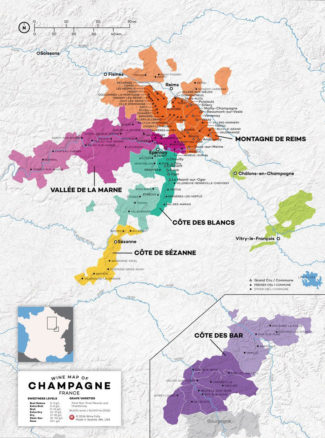
 At its essence, ‘cru’ refers to real estate; its evolution as an often-appearing designation onFrench wine labels is meant to be a nod to the ‘sense of place’ that is fundamental to the concept of ‘terroir.’ But in France, not all crus are created equally. In Burgundy, for example, a cru signifies a vineyard; in Bordeaux, it refers to a chateau or an estate. In Champagne, a cru encompasses an entire village and is based on the classification system adopted in 1920. The Échelle des Crus ranked the more than 300 wine-producing villages in Champagne according to a quality potential based on overall growing conditions and was made manifest primarily by the prices each commune could charge for a kilogram of grapes. In the original classification, 12 villages were rated as Grand Crus (expanded to 17 in 1985) and were entitled to receive 100% of the pricing set by the Champagne appellation for their harvest; 44 were Premier Crus and commanded 90 to 99% of the pricing, and the remaining named villages could charge 80-89%, with none rated lower than that. A bottle may only use the term ‘Grand Cru’ if 100% of the grapes used are from Grand Cru villages, while a bottle labelled ‘Premier Cru’ must be 100% Premier Cru or a mix of both Grand and Premier.
Since 2000, due to potential conflicts with EU law, the Échelle has been used merely as a guide rather than a mandate, but it is still a reasonable assessment of the historic qualities of villages and vineyards and still denotes some of the best areas of Champagne.
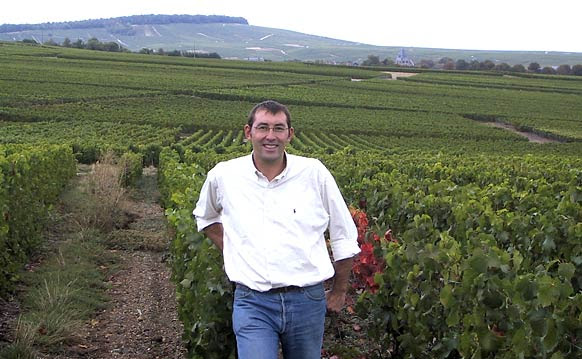
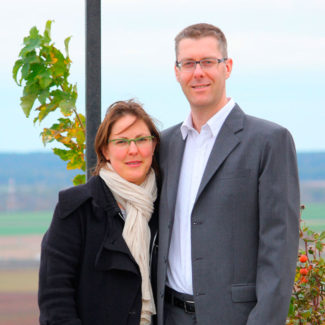
Near the center of the picturesque Grand Cru village of Verzy, overlooking the vineyards of Montagne de Reims, sits Maison Champagne Penet-Chardonnet. Although the estate was only founded in 1967, the families Penet and Chardonnet have viticultural roots in Champagne dating back to the 17th century. The current owner is Alexandre Penet; he took over the Maison in 2007 after having pursued an MBA from the University of Chicago Business School before hearing the siren song of Champagne calling him back to the family estate. There, along with his wife Martine, Penet has created a range of distinctive, top quality wines produced to exacting standards. A firm believer that Champagne should not be viewed strictly as an aperitif, but as an integral part of an entire meal, Penet introduced to Champagne Penet-Chardonnet low dosages and a style that foregoes a secondary malolactic fermentation to allow the wine to express the minerality that characterizes the region. The excess acidity that malolactic would otherwise temper is dealt with by aging. Penet says, “Long ageing on the lees matures the wine and gives it complexity and balance. These Champagnes spend a long time in the old cellar under the house; three years is always the minimum, but more often it is 5-7 years and sometimes even 10-13 years. The longer the ageing on the lees, the more complex the aromas, and that is why we don’t need to add a lot of sugar. The acidity feels milder with the ageing.”
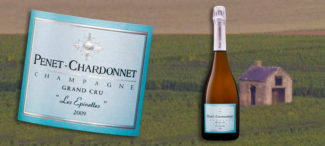
 Highlighting a specific cru is also somewhat rare in Champagne, where cuvées are generally blends of plots from several villages. With “Les Epinettes”, Penet draws exclusively from a single one of the family’s historical lieu-dits in Grand Cru Verzy. Oriented toward the northwest on a gentle slope of chalky limestone, the vineyard is planted exclusively to Pinot Noir with vines over forty years old. Made from 100% Pinot Noir, full-bodied, pure and firm, the wine expresses generous aromas of peach, toasted almond and baked apple over layers of citrus blossom and marzipan and finishes with clean, lively and balanced acidity. With around 3,000 bottles produced, each individually numbered and containing both the harvest and disgorgement date May 16, 2018 and a dosage of 5.6 grams per liter of sugar, Penet considers “Les Epinettes” to be an ultimate achievement of the Penet family’s heritage.
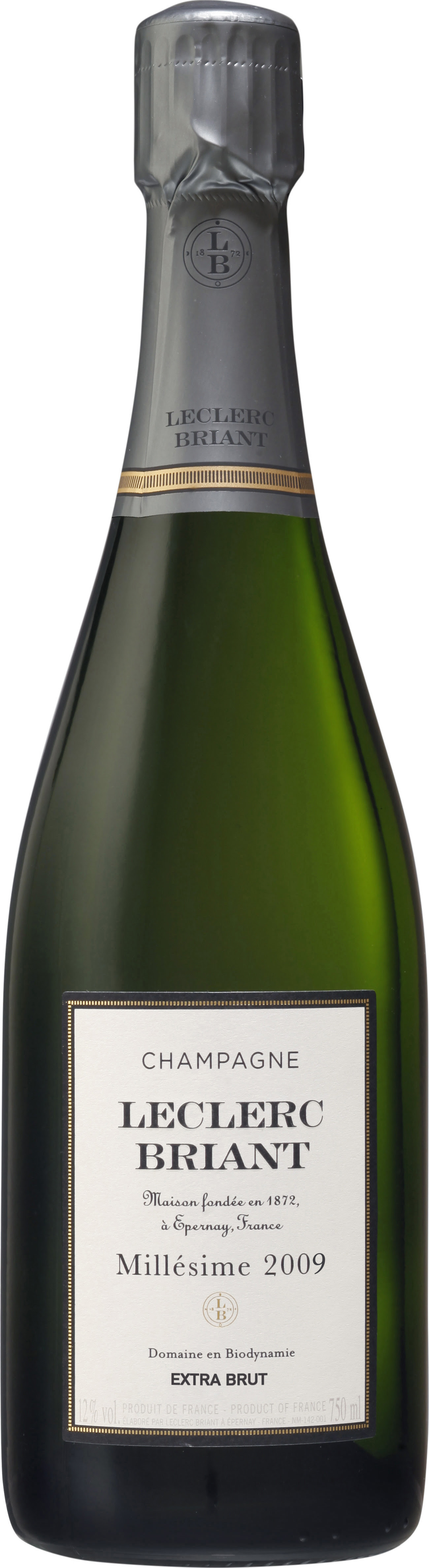
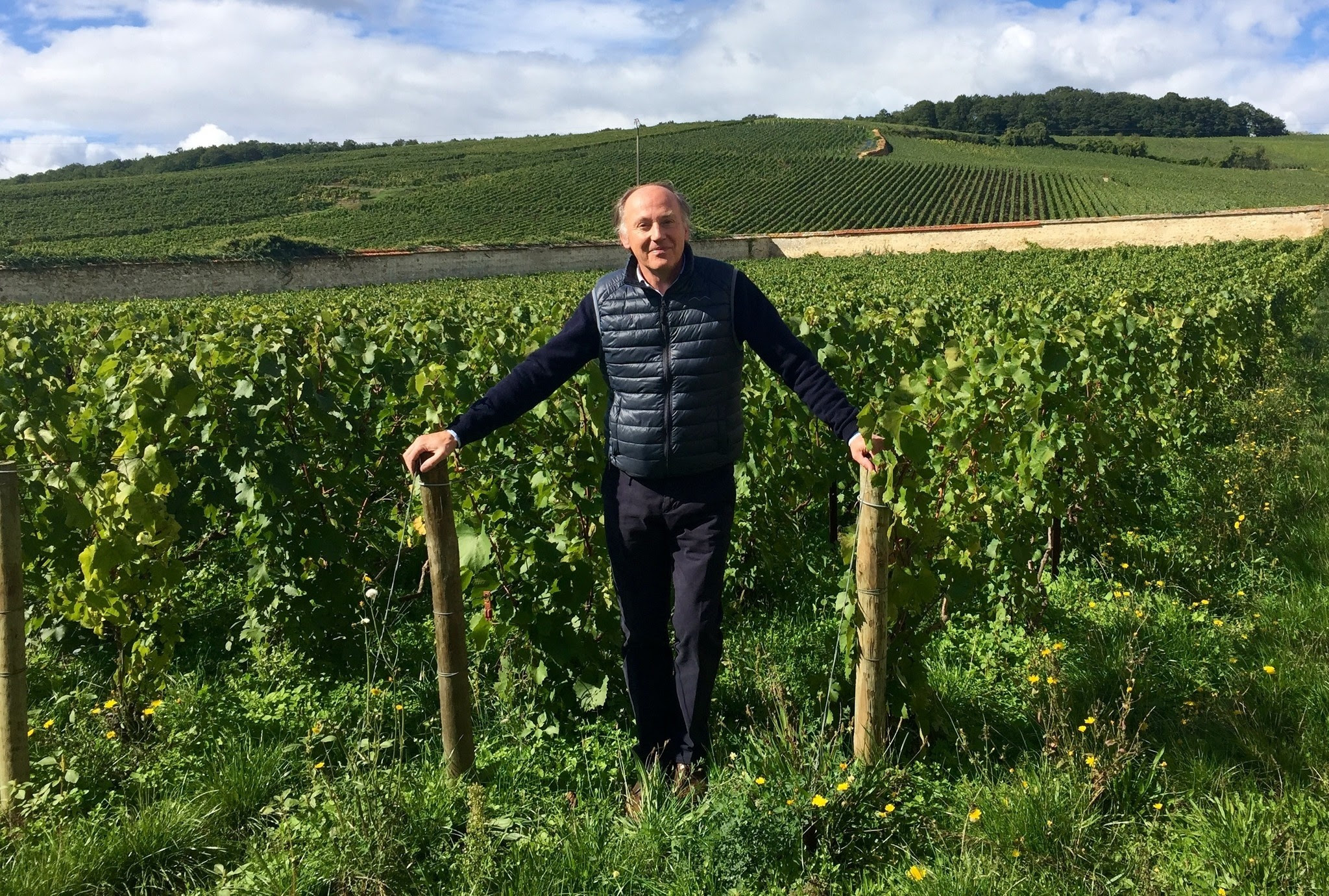 Today, enologist Hervé Jestin continues the legacy of this visionary house.
 Their extensive cellars are more than a half of a mile in length and over 100 feet below the surface — ideal for maturing champagne.
 The average age of his vines are 40 years old with the oldest over 60 years.
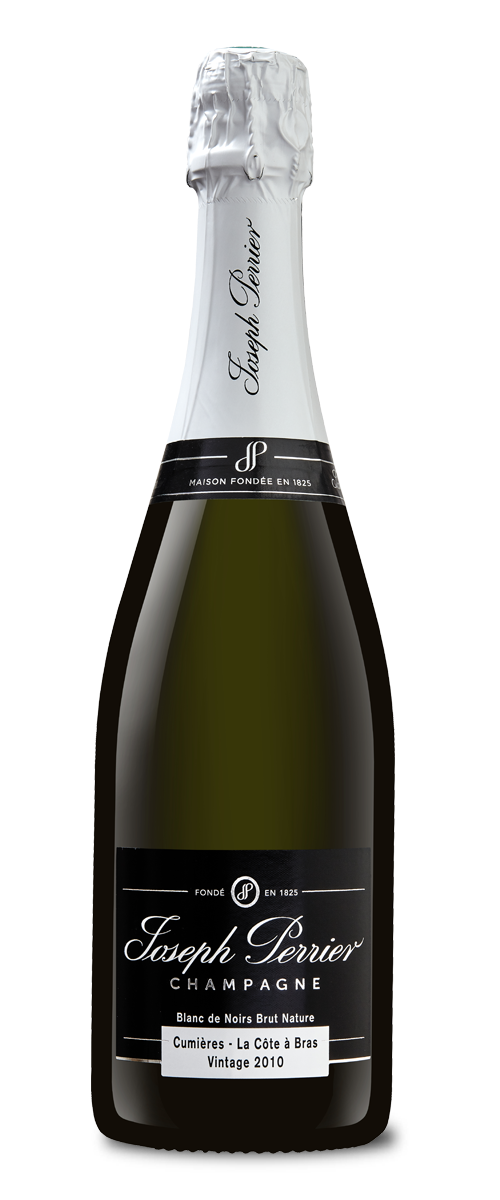 Founded in 1825, the estate has been owned and run by the same family since 1888. Current proprietor Jean-Claude Fourmon represents the fifth generation. The estate’s cellars stretch almost two full miles and date back to the Gallo-Roman period.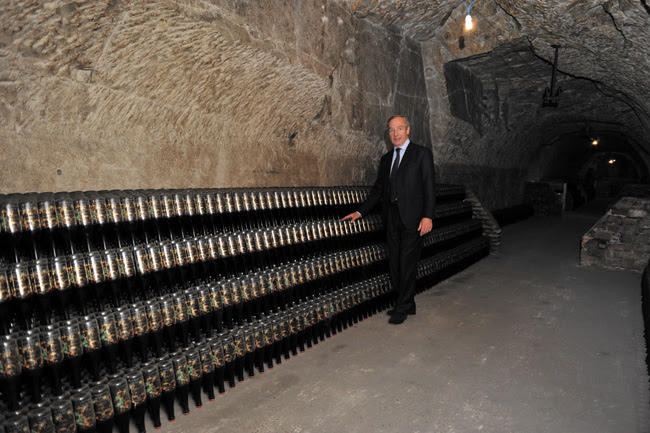
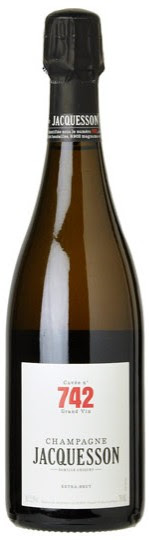 What sets them apart is their goal of producing a wine that expresses the greatness of their vineyard parcels rather than merely maintain a “house style.” Purely on the refinement of its current cuvées,