“Glowing wine on his palate lingered swallowed. Crushing in the winepress grapes of Burgundy. Sun’s heat it is. Seems to a secret touch telling me memory. Touched his sense moistened remembered. Hidden under wild ferns on Howth below us bay sleeping: sky. No sound. The sky… O wonder! Coolsoft with ointments her hand touched me, caressed: her eyes upon me did not turn away. Ravished over her I lay, full lips full open, kissed her mouth. Yum…. She kissed me. I was kissed. All yielding she tossed my hair. Kissed, she kissed me.” – James Joyce, ‘Ulysses’
In the Roaring Twenties, such literary eroticism had its price: ‘Ulysses’ was banned in the United States from 1922 (the year it was published) to 1933, a period of time that roughly mirrors Prohibition. James Joyce’s iconic novel follows—in minute and exhilarating detail—three Dubliners as they meander through the course of a single day, June 16, 1904, and is today considered one of the most important works of literature ever composed.
 Much of the action in ‘Ulysses’ takes place in pubs, where Leopold Bloom—the novel’s main protagonist—shows a particular penchant for Burgundy. In a passage that made the very real ‘Davy Byrne’s Pub’ famous, Bloom orders a Gorgonzola sandwich along with his customary glass of Burgundy.
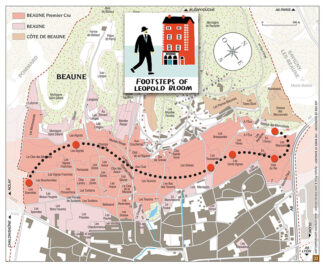
We won’t sell you cheese or bread, because we’re a wine shop. But while Joyce fans across the globe celebrate ‘Bloomsday 2021’ by marathon Joyce readings, pub crawls and bubbly walks through Dublin, we’ll take you on a symbolic stroll along the ancient Route de Bouze, which divides Beaune into two distinct sub-regions, North and South.
We are pleased to offer one bottle of each of the following six wines for an inclusive price of $299. Happy Father’s Day.
• • • • SOUTH • • • •
Domaine Claudie Jobard ‘Gabriel Billard’
Claudie Jobard’s mother is considered one of the top oenologists in France and her father was a ‘pépiniériste viticole’ descended from generations of Burgundian vine growing experts. With a pedigree that illustrious, one expects great things from Claudie, the 8th generation in her family to work in wine. The domain was created by Claudie’s parents in the 1970s and named for her maternal grandfather, but prior to 2004, ‘Gabriel Billard’ was sold exclusively to négociants. It was Claudie’s influence that brought these wines directly to the public, under a winemaking principal that she refers to as ‘la lutte raisonnée’, or ‘the reasoned struggle’ which is conscientious organic farming without the stricture of official certification rules.
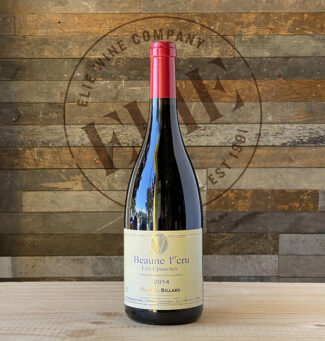 Beaune Premier Cru “Les Epenotes” – Jobard 2014 ($38): The ‘climat’ of Les Epenotes derives its name from ‘épine’—a reference to the thorn-shrubs that once grew here. The wine displays a supple, pretty nose replete with dried cherry and cassis with notes of hazelnut and cocoa; the palate is long and generous, with a hint of smoke and vanilla in the background, finishing with a delightfully rustic piquancy.
Domaine Albert Morot
Virtually synonymous with Côte de Beaune, Domaine Albert Morot was founded in 1820 by a négociant, and by 1890, the family-run business had moved into the same buildings on the Route de Bouze that they occupy today. In 2000, Françoise Choppin—the great granddaughter of the original owner Albert Morot—turned the estate over to Geoffroy Choppin de Janvry, who had prepared for his role by studying agronomy at Montpellier University. The Domaine consists of just under fifteen acres of vineyards split between seven Beaune Premier Cru vineyards: Les Teurons, Les Grèves, Les Toussaints, Les Bressandes, Les Cent-Vignes, Les Marconnets and Les Aigrots.
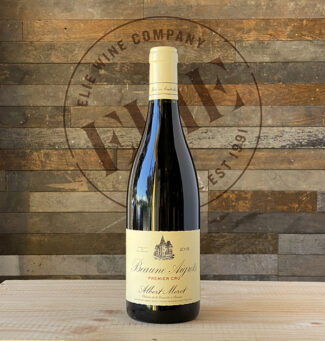 Beaune Premier Cru “Aigrots” – Morot 2015 ($50): Aigrots is another thorny 1er Cru, this one named for the holly shrubs in the west of Beaune where the terroir is typical of the finest Burgundies—calcareous clay, limestone and scree. The wine is expressive and bright, showing black cherry and raspberry up front with a slightly earthy undertone; moderate spice, mostly cinnamon and cola, which warms the mid-palate and leads to a clean, acidic finish filled with silky tannins.
• • • • NORTH • • • •
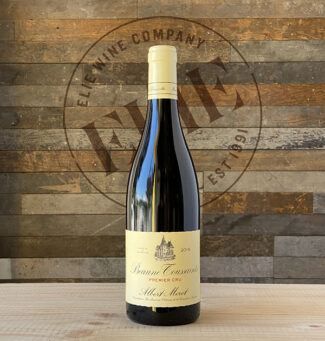 Beaune Premier Cru “Toussaints” – Morot 2016 ($49): More from Morot! Les Toussaints, means ‘all saints’ and lies in the northern sector of Beaune surrounded by some of Beaune’s larger and better-known Premier Crus, including Grèves, Bressandes and Cents-Vignes. Wines from the north tend to be fresher and more elegant than those from the south; this one shows notes of macerating black cherries mingled with rose-petals, lychee and spices accented by chocolate. The structure is powerful and rounded and the finish is satisfyingly long.
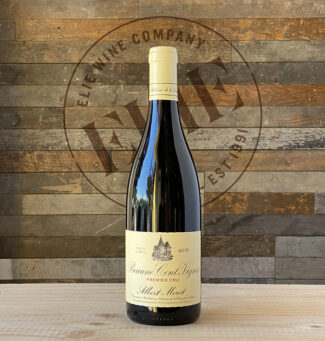 Beaune Premier Cru “Cent-Vignes” – Morot 2015 ($50): This Morot selection hails from the base of the Beaune hillsides, where the lightweight, sandy-textured is typical of lower vineyards where there is an accumulation of scree. The wine is medium-bodied and aromatic; the vividness of the nose is outstanding, and the on the palate, the fruit tends toward the red side of the spectrum, with tart cherry and wild raspberry along with a soil-driven earthiness.
Domaine Rapet
The family estate of Rapet dates to 1765; today, the domain’s 35 acres of vines stretch across the villages of Pernand-Vergelesses, Beaune, Savigny-lès-Beaune, Chorey-lès-Beaune and Aloxe-Corton. Current owner Vincent Rapet is known for a classical approach to winemaking, both in the field and in the cellar. Along with his wife Sylvette he oversees parcels in three Grand Crus, Corton-Charlemagne, Corton, and Corton Pougets, and nine in Premier Cru vineyards. His Pinot Noir-based wines see an average 15-day maceration period followed by maturation in 228-liter oak barriques, of which about 30% are new wood.
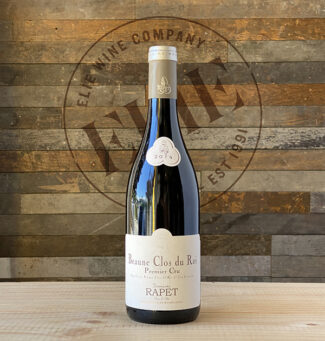 Beaune Premier Cru “Clos du Roi” – Rapet 2014 ($46): Clos du Roi is a small vineyard, but without doubt one of the best plots in Beaune. Once owned by the dukes of Burgundy and highly favored at Versailles, the site enjoys a perfect south/south-easterly exposure. This produces wines with sinew, rich and flirtatious with flavors of glacé cherries, crushed stone, licorice and mint. A friendly mouthfeel with sweet oak and austere minerality to rein it in.
Domaine Paul Pernot
Paul Pernot’s grandfather was a négociant in Puligny and the fifteen acres he owned had been in the family for over two centuries. Ironically, the ground was largely unsuited to vines—at least, until the advent of modern technology (tractors) allowed the hard limestone surface rock to be worked. Founded in 1959, Domaine Paul Pernot proceeded to do exactly that, and today, 65% of his property is found within the commune of Puligny-Montrachet, including plots in Les Folatières, Les Pucelles, Clos de la Garenne and Champ Canet, and two Grand Cru parcels: Bienvenues Bâtard-Montrachet and Bâtard-Montrachet. As such, he is one of the top growers in Puligny.
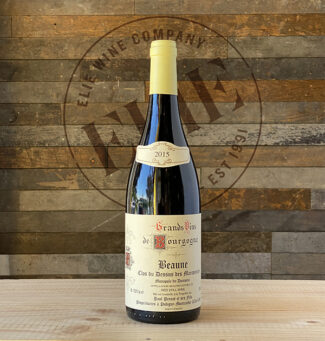 Beaune Lieu-dit “Clos du Dessus des Marconnets” Monopole – Pernot 2015 ($49): Among the 35% of Pernot land not in Puligny, Les Marconnets sits on the east-facing slope of Mont Battois hill in the southern part of the Savigny-lès-Beaune. The wine is round and racy, showing a nice brick rim in the glass behind a pungent nose of plum and truffle and a fragrant herbal thread that winds through. A brilliant example of the lieu-dit, with floral high tones, mineral purity and a vibrant, beautifully integrated tannic structure.
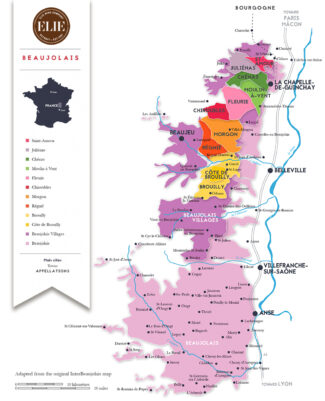
 In the 18th century Château du Moulin-à-Vent was called Château des Thorins, named for the renowned vines on the hillsides of Thorins—a Mâconnais proverb runs, “Every wine is good with a meal, but a meal cannot be enjoyed without Thorins.” The estate was purchased in 2009 by the Parinet family, who has made a marvelous effort to extract the most from the chemical-rich terroir—the underlying granite soil contains iron oxide, copper and, of course, manganese. Château du Moulin-à-Vent, Moulin-à-Vent – Le Moulin-à-Vent 2018, ($40), comes from an exceptional vintage and is one of the château’s signature wines, sumptuous and expressive. It shows juicy black fruits, lavender and a myriad spices from the partial oak-aging.
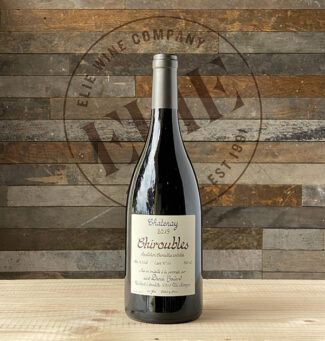 Daniel Bouland is an artisan in the style of old-school winemakers. He works his vines by hand, and many are grown in small plots known as lieu-dits—portions of a vineyard with specific topographic or historical significance. Better known for his Morgons, Daniel Bouland ‘Cuve No 11’, Chiroubles-Chatenay 2019, ($36), hails from such a lieu-dit (Chatenay) in the neighboring appellation of Chiroubles, on a steep hillside site composed of friable sandstone. Such terroir produces beautiful, fragrant, sappy Gamay wines with the structure of many Burgundies. It has a nose of violets and thyme, a rich mid-palate of cherry and cranberry underscored by orange peel, Damson plum and crisp minerality.
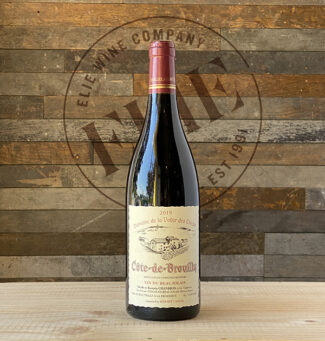 Domaine de la Voûte des Crozes, Côte de Brouilly 2019, ($23). So highly is La Voûte des Crozes winemaker Nicole Chanrion regarded in Côte-de-Brouilly that in 2000, she was elected president of the appellation. With oversight of all aspects of the process, from winter pruning, to managing the canopy, hand-harvesting and fermentation, she produces a wine whose tannins match ripeness of the fruit. Ample and layered with a succulent core of black-cherry, the acid remains front and center while a streak of minerality reflects the volcanic schist terroir.
 The artisan vigneron reappears in Côte de Brouilly with Daniel Bouland ‘Cuvée Mélanie Cuve No 1’, Côte de Brouilly 2019, ($36), a wine comparable in complexity, depth and cellaring potential to a Côte de Beaune. Another lieu-dit gem, this wine shows kirsch fragrances along with cassis, blackberry and smoke. Like all of Bouland’s wines, this one is made from hand-harvested grapes, vinified with full clusters and bottled unfiltered.
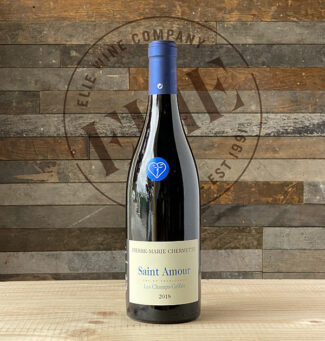 Pierre-Marie Chermette was raised in the vineyard; his fondest memories of the family home in Vissoux was riding the tractor. He pursued it as his life’s work, earning a National Diploma of Oenologist from Dijon at the age of 20. Two years later, he convinced his father to stop selling the fruits of his labor to merchants, and developed the market for estate bottled wines. Over the years, Pierre-Marie diversified the number of appellations the family worked, and is now responsible for nearly 75 acres. For obvious reasons, Pierre-Marie Chermette, Saint-Amour-Les Champs Grilles 2018, ($30) is marketed for Valentine’s Day, for which it is perfectly suited: The nose is rose petals and cherry blossoms, and the palate is filled with lush red fruits and chocolate layered across gentle tannins.
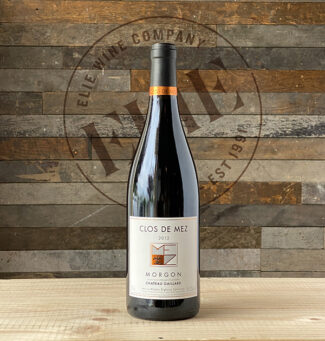 Marie-Élodie Zighera-Confuron is the proprietor of Clos de Mez, and maintains the vineyards’ matriarchal lineage. She explains, “Vines have been in my maternal family for four generations. The grapes they grew were delivered to the cooperative cellar by my grandmother and mother, up until I arrived at the domain as a winegrower. However, this did not deter my grandmother or mother from taking great care of the vineyard.” Clos de Mez, Morgon-Château Gaillard 2012, ($22)is not to be confused with Normandy’s Château Gaillard; here it is a lieu-dit in the northern part of Morgon bordering on Fleurie. The vines are all over 60 years old; they produce a distinctive, meaty wine that has been compared to a Rhône for its dark cherry profile enlivened by licorice, plum and a taut, mineral-tinged acidity.
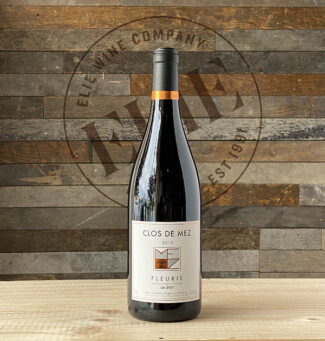 Clos de Mez, Fleurie-La Dot 2012, ($22)sees the return of Marie-Élodie Zighera-Confuron to her native Fleurie, where La Dot refers to a plot of vines, now fifty years old, that her grandmother once received as a dowry. White flowers and cut grass waft through the nose and lead to a beautiful palate of pomegranate and raspberry; the wine finishes with granitic acidity and a dusting of baking spices.
 Pierre-Marie Chermette, Fleurie-Poncié 2017 ($27) also reintroduces the tractor-fan turned enologist from Le Vissoux. Although the family estate is in Saint-Vérand, in the Golden Stone area of Rhône, the luscious Fleurie from the lieu-dit Poncié is a paean to the sandy slopes of pink granite north of the town itself. The wine is resplendent with sweet red cherries, dried flowers and ripe strawberries enveloped in silky tannins.
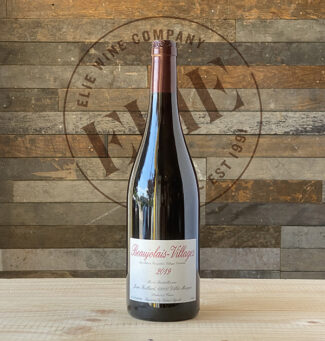 Jean Foillard, Beaujolais-Villages 2019, ($27), is a solid example of the classification, brilliant red with a purplish tint, offering round, juicy mouth-filling strawberry and cherry flavors with spice in the background and a rustic, lightly tannic finish. A disciple of traditionalist Jules Chauvet, who eschewed the styles touted by commercial brands, Jean Foillard produces wines that are sumptuous and complex, with a velvety lushness that makes them irresistible in their youth.
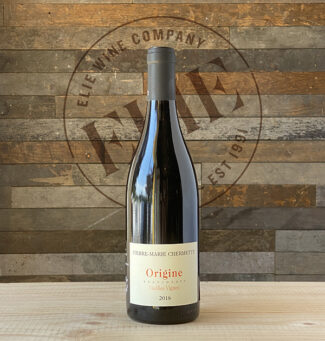 Pierre-Marie Chermette ‘Origine Vieilles Vignes’ Beaujolais 2018, ($18), falls under this generic appellation with the specification of ‘Origine Vieilles Vignes’, or ‘original old vines’. It is produced in Saint Vérand from vines that have grown on a dark granite enclave for up to a century. The cuvée was created in 1986 when banana-flavored Beaujolais Nouveau was in vogue; Pierre-Marie wanted to create a non-chaptalized spring-release Beaujolais using natural yeast and vinified by using traditional methods. It is bright and beautiful, suave and supple, and exhibiting great color and freshness.
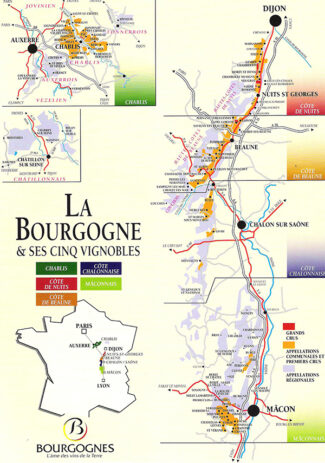 Chablis
 Credit Napoléon’s loss at Waterloo for the establishment of Domaine Billaud-Simon; Charles Louis Noël Billaud returned home from the war to plant vines on the family holdings in Chablis. A century later, the estate expanded with the marriage of his descendent Jean Billaud to Renée Simon. Since 2014 owned by Erwan Faiveley, the 42-acre site produces wine from four Grand Cru vineyards, including single-acre plots in Les Clos and Les Preuses. The Domaine also owns four Premier Cru vineyards, including Montée de Tonnèrre, Mont-de-Milieu, Fourchaume and Vaillons. Chablis 2017 ‘Tête d’Or’ ($46) is sourced from 28-year-old vines from a parcel sitting at the foot of the Premier Cru Montée de Tonnerre in the heart of the Chablis appellation; the name means ‘Head of Gold’ and shows pure green-apple and bitter almond with an almost saline-like intensity. It’s a letter-perfect oyster wine, nicely nuanced with graphite, grapefruit and lemon.
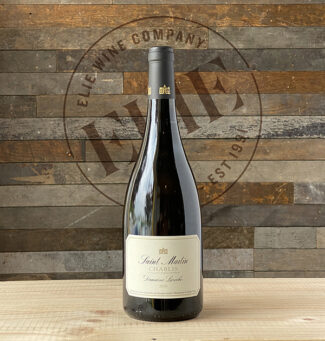 Vines were first planted in the confines of what is today Laroche the same year that algebra was invented; in 2021, both mathematics and Laroche are still going strong. Today, Domaine Laroche is one of the largest landholders of Grand Cru vineyards in Chablis, with 222 acres spread across the entire region. Michel Laroche—whose name is held in the same reverence in Chablis as Michel Chapoutier’s is in northern Rhône or Olivier Humbrecht’s in Alsace—relies on one-man plots, meaning that a single person is wholly responsible for the care of each vineyard parcel, from the pruning, soil conditioning and control of yields to the sorting of the harvest. Chablis 2018 ‘Saint-Martin’ ($32) is named for the patron saint of Chablis, a Roman cavalry officer who became a monk and was elected Bishop of Tours. The cuvée is a blend of the best plots, all sit on Chablis’ legendary Kimmeridgian soil, and produce excellent acidity and remarkable finesse. The wine shows Bartlett pear and lily on the nose, pineapple and honey in the mid-palate and violet and candied lemon on the textured, creamy finish.
 The pedigree of the Moreau name dates to 1814 when barrel-maker Jean-Joseph Moreau founded a wine-merchant trading firm in Chablis. Although that original firm has changed hands several times, including a sale to Hiram Walker in 1985 and again to the Boissets of Nuits-Saint-Georges in 1998, the Moreau family never relinquished control of their vineyards. Domaine Christian Moreau Père et Fils began vinifying at the turn of the 21st century, and is now under the watchful care of Fabien Moreau: “Being the 6th generation of the family producing wines, was and still is a challenge for me, trying to avoid the pressure you could have with this wine heritage. But with the quality of the vineyard that my family passed on, the basis of the expression of our wines is here, and our work is to honor our terroirs.” Chablis 2018 ($36) is a cuvée built from grapes purchased from the bordering villages of Fontenay-Près-Chablis (near Fourchaume) and Béru. It is a taut, compelling wine that reflects a mineral-tinged sharpness that the French describe as ‘goût de pierre à fusil’—gunflint—alongside aromas white hawthorn flowers and a cut of citrus.
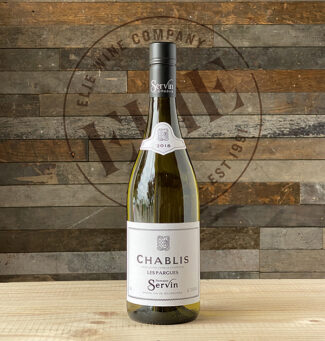 When you’ve been growing wine grapes in Chablis since 1547, post-Napoleonic upstart houses are the new kids on the block. With so many generations of winemakers and a pantheon of awards that span centuries, it is to be expected that the philosophy of Chablis, when uttered by a Servin, should be heeded. Says François Servin, the current winemaker, who was raised on vintages like 1929, 1947 and 1959: “A good Chablis is not a wine which is very elegant when young; Chablis for me is a wine which is good over 20 years.” This keen understanding of older vintages convinced him that malolactic fermentation combined with late bottling increases the ageing capacity of his wines. Chablis 2018 ‘Les Pargues’ ($27), planted in the vineyards behind the Premier Crus Vaillons and Montmains, employs a judicious blend of barrels and stainless-steel vats to create a wine that is concentrated and mineral-driven, showing natural mellowness, a touch of anise and lemon-peel balanced by smoke and earth.
 Many of them are labeled AOP (Appellation d’Origine Protégée) rather than AOC (Appellation d’Origine Contrôlée), the French designation of top quality. As legal guarantees (limited production area, compliance with specific production standards and established name recognition) the terms are pretty much interchangeable; they are simply awarded by different authorities. First created in France in 1905 and recognized internationally since 1958, ‘AOC’ as a label-dresser is gradually being supplanted by the Europe Union’s AOP. ‘Vin de Pays’ is also being phased out in favor of the EU’s IGP (Indication Géographique Protégée), a term that covers wine from a designated area. In some cases, they are as good or better than AOP wines, but produced according to standards that may stray the strict regulations of AOP/AOC.
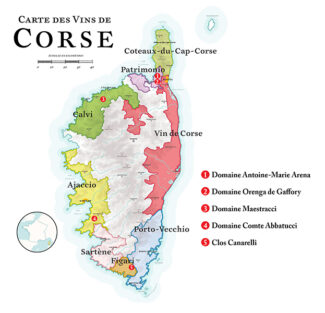
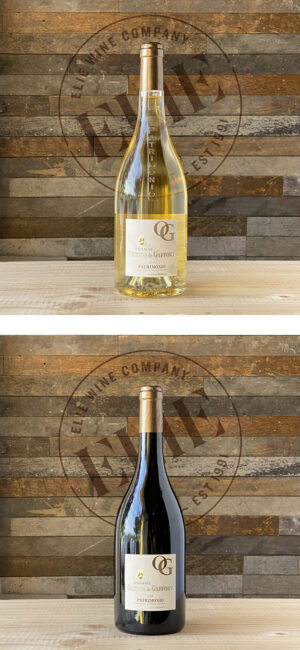 In parcels between the towns of Saint-Florent and Poggio-d’Oletta in the beautiful Patrimonio appellation in northern Corsica, Henri Orenga de Gaffory has been exploring unique terroirs since 1966. Finding them best expressed in traditional varietals, he dedicates his 150 acres to raising limited-yield Niellucciu, Vermentinu, Minustellu, Aleatico, Muscat and of course, the standby blending red, Sciaccarellu. Wine folks are familiar with at least a couple of them, but as to the rest, would be hard-pressed to bet on whether they were white or red. Here’s your hint: AOP Patrimonio 2019 White ($22) is 100% Vermentinu, grown in soils that are an equal blend of limestone, chalk and clay. It has an electric lemon-lime palate behind a white-flower bouquet tinged with brine. With another year of aging, honeyed wax notes will become more pronounced. AOP Patrimonio 2018 Red ($20) demonstrates the same terroir’s expression of Niellucciu—a native grape that must, by Patrimonio law, make up 90% of the blend with the balance in Grenache. It’s a robust and silky wine displaying fruits, peppery spice and licorice, tinged with mineral throughout.
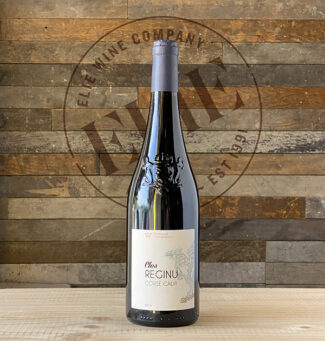 Inland from Calvi, the granite plateau of Reginu provides a microclimate known in Corsica as ‘U Vinu di E Prove’. Conditions there are familiar (and ideal) to those who understand diurnal shifts as it relates to the production of fine wine. Daytime temperatures rise to sweltering heights, but nights are high-elevation cool; the combined effects develop the sugar and stubbornly hold onto the ripening fruit’s natural acidity. On the estate of an old olive grove, Roger Maestracci saw an opportunity for vineyards; essentially the only two crops which thrive under these conditions are olive trees and grape vines. The estate is now run by his granddaughter, Camille-Anaïs Raoust, who refers to ‘Clos Reginu’ AOP Corse Calvi 2019 ($19) affectionately as ‘Clos Reggie’. It is a blend of grapes that may have been unfamiliar to you before tasting through this package, but which may have become new friends: 30% Niellucciu, 30% Grenache, 15% Sciaccarellu, 15% Syrah, 5% Mourvèdre and 5% Carignan. It is a juicy, spicy, herb-scented, mouthwatering red wine that can serve as the foundation to any summer meal enjoyed outside.
 In Corsica, the name ‘Abbatucci’ is seen as frequently as Washington in the United States, and for much the same reason—General Charles Abbatucci (from Ajaccio) was a hero of the French Revolution. The Domaine that bears the name is run by a direct descendent of the General, Jean-Charles Abbatucci. A fanatical exponent of the most eccentric of biodynamic techniques, the names of his blends are as flamboyant as the product behind the label—‘Cuvée Collection – Ministre Impérial’ Vin de France 2016 ($89) is composed of 22% Sciaccarellu, 18% Niellucciu, 15% Carcajolu-Neru, 15% Montanaccia, 12% Morescono, 10% Morescola and 8% Aleatico, drawing nuances from each of these fascinating varieties. Named for a leading military figure under Napoléon Bonaparte’s Premier Empire (who then became a consul under Napoléon III) the grapes are crushed by foot and macerated for 15 days before being aged in 600-liter demi-muids. The nose is an exotic combination of flower perfumes and exotic berry spice, and the wine unfolds with complexity, intensity and richness, with flavors of bramble fruits, cola, garrigue, good acidity and a backbone of toasted oak.
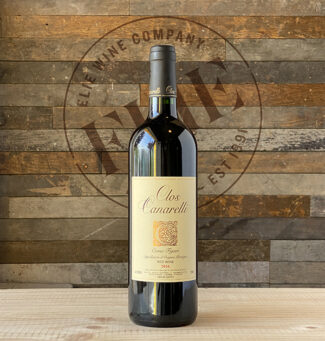 Yves Canarelli left a career in economics to return to his family’s wine estate on the somewhat brutal southern tip of Corsica, where temperatures have been known to soar to 109°F and rainfall rarely exceeds thirty inches annually; in the Figari appellation, the soil is essentially a sparse dusting of granitic red alluvia. Canarelli has championed the return of native varietals, which thrive in there in such conditions; he is one of the pioneers who advocated tearing out foreign grapes in favor of those first planted in Corsica since Phoenician times. Likewise, he uses only indigenous yeasts, and prefers slow, deliberate, precise fermentations, then leaves his reds unfiltered. AOP Corse Figari Rouge 2016 ($45) is a blend of 80% Niellucciu, 15% Syrah and 5% Sciaccarellu; it delivers a bold and intense presentation redolent of black cherry and dried blackberry with sweet almond, toasted spice and balsam in the finish.
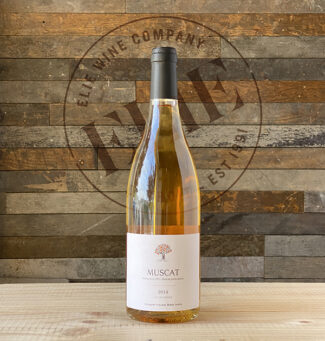 When legendary Corsican producer Antoine Arena split his Patrimonio estate into sections, each of his sons got a piece. To his parcel, Antoine-Marie brought not only experience from his native Ile de Beauté, but his enological and viticultural studies in Hyères as well as internships in both Burgundy and Provence. He explains, “Working as a family is great, but the Corsican spirit of liberty and independence guided us in this decision.” Fulfilling both ideals, he constructed his new wine cellar across from the family home and has begun own legacy with a series of remarkable releases from the vineyard Morta Maìo—translated as ‘The Eldest Myrtle’, referencing the myrtle shrub found throughout Corsica. ‘Morta Maìo’ Muscat, Vin de France 2014 (Sweet White) ($50) is from Antoine-Marie’s first solo vintage, and shows the complexity of Muscat as a dessert wine; notes of sultana and apricot underscore silky peach and luscious beeswax, and in the finish, candied orange and bergamot. The wine is referred to as ‘non-mute’ or ‘vin doux naturel’ which in the parlance of the craft means that no alcohol is added; the 13.5% ABV comes entirely from natural grape sugars.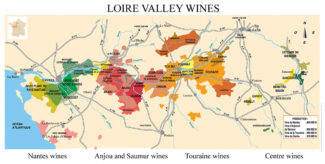
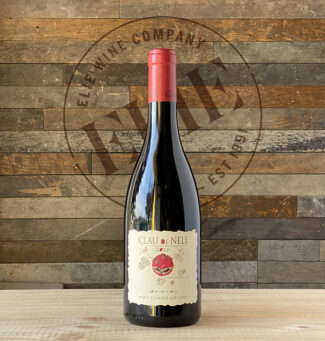 Clau de Nell is also centuries old, but its modern era began in 2008 when Anne-Claude Leflaive (owner and winemaker at Burgundy’s famed Domaine Leflaive) discovered the 20-acre property while on a promotional tour of her biodynamic approach to viticulture. She purchased the domain, finding the situation ideal: a south-facing knoll 295 feet above sea level, from which the Atlantic Ocean—75 miles away—is visible. The vines are planted in sandstone and red flint overlaying the soft limestone ‘tuffeau’ indigenous to the region; they range in age from 30-90 years. 2016 Clau de Nell “Cabernet Franc” ($59) has reached a prime drinking age; it shows rich, jammy raspberry and dusty pencil graphite, but tension on the palate is sustained as the acids remain charged and energetic.
 For a region dotted with beautiful historic homes, Château du Hureau is one of the few wine-producing châteaux among them. It is considered a top producer of Saumur-Champigny, with a milieu that is as breathtaking as the vineyard view, including the octagonal tower with mansard roofs and boar-headed weathervane from which the property derives its name. The estate contains multiple terroirs, and releases examples of each as ‘parcellaires’—wine from exclusive parcels. 2014 Château du Hureau ‘Lisagathe’ ($44) is named for fourth-generation winemaker Philippe Vatan’s two daughters Lisa and Agathe; it is made only in exceptional vintages. And only from selected portions of the estate’s best vineyards, located above the underground cellars. Full of mint-fresh young fruit, the wine expresses the classic smokiness of the AOP, with elegant undertones of chalk, flowers, pencil shavings and velvet-smooth tannins.
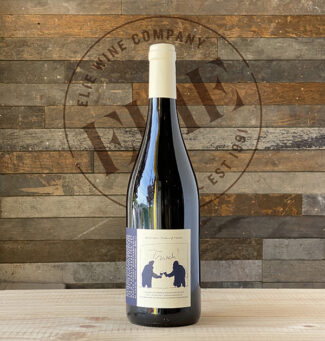 Catherine and Pierre Breton have been coaxing superlative wines from this terroir for decades; they cultivate 35 acres in the village of Restigné, just east of Bourgueil. Poetically, they grow mostly Cabernet Franc—the local term for this varietal is ‘Breton.’ Pierre remains the principal cellar master, although Catherine makes a series of cuvées under the label ‘La Dilettante.’ These wines are into three categories: Natural (for easy, early consumption), Classic (representing a profile of the appellation) and Wines of Terroir (vinified by individual parcel). 2018 Breton ‘Trinch!’ ($24) is an example of the former, produced from young-vine Cabernet Franc and referred to as ‘bistro-style’ for its quaffability. Indeed, ‘Trinch!” is a German variation on ‘cheers!” Lively, crisp and filled with juicy cranberry notes above an herbal-tinged core. A wine best enjoyed slightly chilled on any delightful and non-pretentious occasion.
 The Baudry family is also deeply-rooted in Chinon, although their education spans appellations outside the Loire, and extends as far in the wild red yonder as Tasmania. Bernard Baudry, the patriarch, studied oenology in Beaune and worked as a vine-tending consultant at Tours. His son Mathieu studied in Mâcon, then in Bordeaux after the year he spent working in Tasmania and California. The Baudry domain covers 80 acres across the AOP Chinon with additional parcels in Cravant les Coteaux; 90% of the property is planted to Cabernet Franc with the remaining to Chenin Blanc. Both father and son refer to the 2018 vintage as “Magnifique!” with a mild winter and springtime producing enough rainfall to recharge the groundwater which fell after a dry 2017. 2018 Baudry ‘Les Grézeaux’ ($25) pays homage to the gravelly soil beneath the parcel; earthy and rich, the wine showcases Cabernet Franc’s meatier persona. A rustic wine with great concentration and delightful spice, winemaker Baudry considers ‘Les Grézeaux’ to be textbook Chinon.
 M. Rabelais is not the only playwright connected with Loire wines; at the helm of Domaine Philippe Gilbert is Philippe himself, a ‘dramaturg’ (his description) who has written and produced for the stage. Today he is a winemaker foremost, having returned to the village of Faucards in Menetou-Salon to run the family estate, a winery whose history dates back to 1778 and his forefather
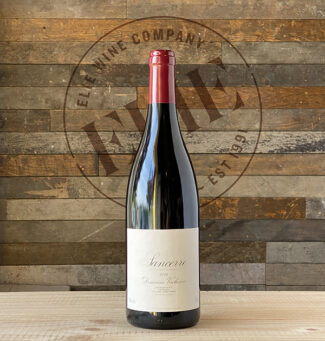 Cousins, Jean-Laurent and Jean-Dominique Vacheron have no issue learning from the masters; having converted entirely to biodynamic viticulture in 2005, they have opted to use techniques from the Burgundy playbook to encourage the most potential from their scant thirty acres of Pinot Noir, which sits primarily on flinty silex soils. 2018 Domaine Vacheron ($56) is nicely structured with focused plum and sour cherry in the mid-palate and a rich, pure and persistent finish.
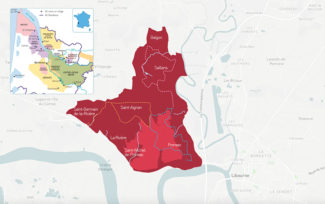 The Right Bank itself boasts a number of exalted châteaux, of course, especially within Saint-Émilion and Pomerol. But it also contains phenomenal, lesser-known ‘satellite’ appellations which—in part by existing within the fame-shadow of Right Bank superstars like Château Angélus and Cheval Blanc—produce excellent wine whose prices are more in accord with content. One such example is Fronsac, known as ‘the Tuscany of the Gironde’ for its spectacular hillside vineyards overlooking the gentle Dordogne and the river Isle. The wines of
  Foreign ownership is by no means rare in Fronsac; fully 13% of the châteaux are owned by Chinese investors—a higher percentage than any other Bordeaux wine appellation. Although
  Through two centuries and seven generations of vignerons, a single family has seen this estate through the thick of mid-18th century (when the wines of Fronsac rivaled those from nearby Saint-Émilion and Pomerol in both price and reputation) to the thin of the phylloxera plague of 1850 – 1870 which saw many of the hillside vineyards abandoned or neglected. Octave Trocard, at the helm of Villars at the turn of the 20th century, having won a gold medal at the 1907 World’s Fair in Antwerp, perished in World War I and left the property to his two daughters. It was their tutor who looked after the estate until the girls came of age, and in 1934, the eldest daughter married Jean-Jacques Gaudrie, who set about a quest to recapture the
  Nestled in the heart of the fiefdom where Charlemagne once built fortresses, the history of
 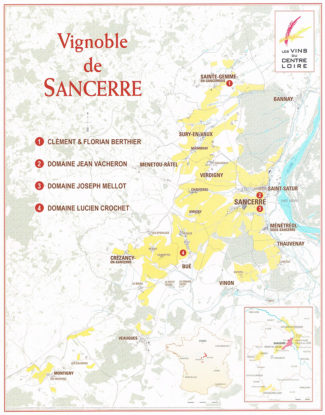 Separated only by the width of the river, Sancerre overlooks Pouilly Fumé with a sort of supercilious smirk. Sancerre’s interpretation of Sauvignon Blanc tends to more finessed, showing less minerality and more fruit than Pouilly Fumé, less flint-spark smoke and more flowering herb aromas and tastes without being as aggressively citrusy or grassy. This is a generalization, of course. Sancerre is comprised of a varied geology, and wines from individual terroirs express one-of-a-kind characteristics. To the east, flinty soils produce wines of almost steel-like elegance and austerity; the central vineyards are chalky and the wines are more floral and delicate and almost Chablis-like, while in the gravelly northwest, Sancerre tends to reflect an array of unusual fruits, many exotic—passion fruit, quince and lychee. All three plead a pretty respectable case that— Marlborough, Willamette and Graves notwithstanding—Sancerre is Sauvignon Blanc’s purest sanctuary. In ways, throughout Loire’s culture, purity is the hallmark, and the folks who live here are reputed to have the purest of all French accents.
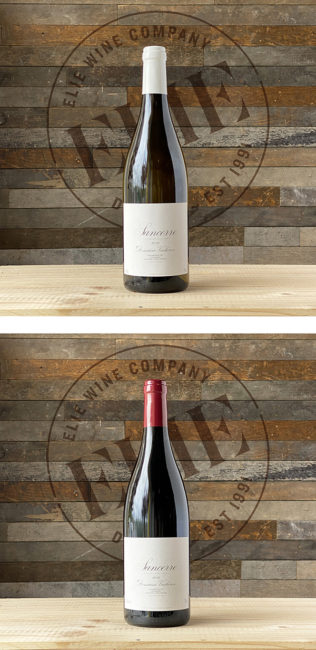 With over a hundred biodynamically-farmed acres and vines with an average age approaching half a century, Vacheron is one of the elite properties in Sancerre and cousins Jean-Laurent and Jean-Dominique Vacheron are among the top artisan winemakers in the Loire. Focused on single vineyard sites while hand-harvesting fruit, the Vacherons have produced primarily Sauvignon Blanc, but are also winning high marks for the twenty-five acres of chalk and silex that they have planted to Pinot Noir. These reds undergo malolactic after primary fermentation in foudres and neutral barriques, softening the acids and showcasing the fruit. The two wines in the package are exemplary both of the Vacheron style and of the appellation. Sancerre White 2019 ($46)displays a bright bouquet of Bosc pear, lime and dried yellow flowers and a rich, mouthwatering palate of citrus and sage with an edge of minerality. Sancerre Red 2018 ($56) highlights the warm vintage, which was especially kind to Pinot Noir, and produced a full-bodied wine that reflects warm cranberry, strawberry compote and tart cherry notes along with taut tannins that form a supple backbone.
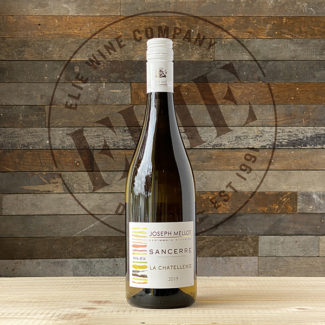 Domaine Joseph Mellot
 A match made in Sancerre heaven? Lucien Crochet’s marriage to the daughter of Lucien Picard fused not only families, but wine estates; Crochet expanded the work of his father-in-law and, over the next forty years, grew the
  Like many French wine estates,
 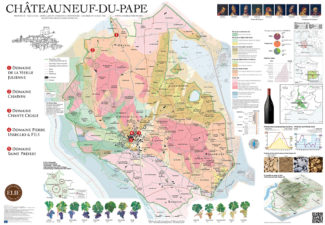 Limited to five communes, Châteauneuf-du-Pape commands prices worthy of its reputation, but many of the estates own vines just outside the tight borders and there are some plots on which some vineyard rows may be labeled Châteauneuf-du-Pape and adjacent rows, Côtes du Rhône. The finest of these face the challenge of bureaucracy rather than terroir. We firmly believe that the following wines offer extraordinary ‘CdP-esque’ quality at a phenomenal price; they are suited to those who drink for the wine instead of the label. A 10-bottle pack, two of each, for an all-inclusive price of $299.
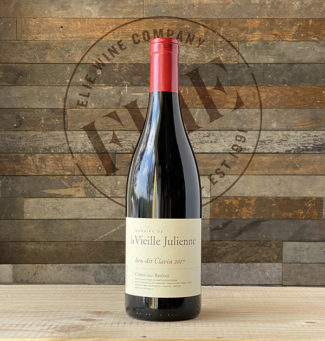 Domaine de la Vieille Julienne’s
 On the southern end of Châteauneuf-du-Pape, owner/winemaker
  Founded in 1948 by Italian winemaker Francis Usseglio, the domain released its first vintage the following year. Since then, the family has nurtured 17 parcels over almost fifty acres situated within some of the best terroirs in Châteauneuf-du-Pape, and today, brothers
 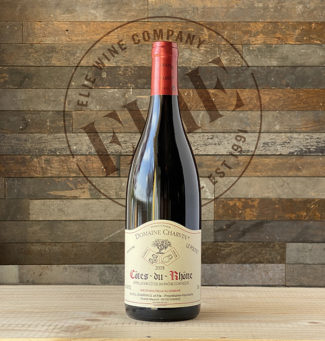 Laurent Charvin tends vines in the northwest end of Châteauneuf-du-Pape, primarily in Cabrières, Maucoil and Mont Redon. He farms organically, and vinifies old-school, without de-stemming and fermenting in concrete tanks for 21 months before being bottled unfiltered. From a sandy, north-facing hillside, “Le Poutet” 2018 ($26) is an exemplary Côtes du Rhône that shows Grenache elegance with ripe blackberry and mulberry mingled in bramble and spice. The palate is intense and generous and is wonderful testimony to the winemaker’s attention to detail.
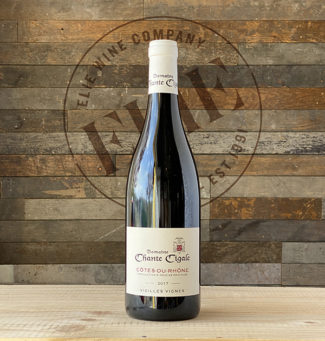 The roots of this domain extend back to 1874, when the delightfully-named Hyppolite Jourdan christened the estate Chante Cigale, meaning ‘song of the cicada’, as can be heard throughout Southern Rhône.
 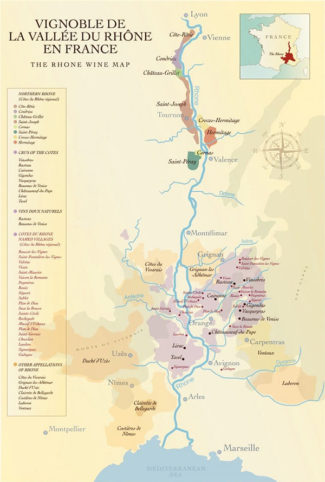 Just beneath the ancient city of Lyon, the Rhône River does a rakehell turn westward, then at Vienne, another turn toward the east before again heading south. That’s where you stumble upon the first vines of the Northern Rhône, many planted on steep hillsides and most of them on the river’s right bank. Côte-Rôtie—the ‘Roasted Slope’—is the northernmost appellation within the Rhône Valley and renowned for these terraced, river-hugging vineyards. Syrah reigns in Côte-Rôtie, but not supreme: Appellation rules allow for the addition of up to 20% Viognier, adding to the wine’s characteristic aroma of flowers and leather. Viognier’s true kingdom is just below Côte-Rôtie, in Condrieu—a winding nine-mile stretch of vineyards—where this aromatic, peach-scented white wine is produced in Lilliputian quantities to Brobdingnagian applause. Further south, Syrah regains its foothold: Although the sprawling mega-appellation of Saint-Joseph may, like Côte-Rôtie, blend white varietals into their red wine, and white Hermitage, white Crozes-Hermitage and Saint-Péray are all made from Marsanne/Roussanne, the vast majority of Northern Rhône is given over to the production of Syrah. This may range from tiny, under-appreciated Cornas to elevated, perhaps over-appreciated Hermitage. Below Northern Rhône is a different wine world entirely; Southern Rhône is warmer and flatter and employs multiple varietals to create wines essentially unlike those of their northern neighbors.
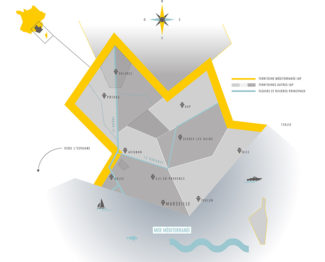 Of more than passing note (driven in part by its affordability) is the Collines Rhodaniennes IGP which encompasses all of Northern Rhône, but represents country wines built not on tradition or AOC (relabeled AOP ‘Appellation d’Origine Protégée’ by the European Union) rules, but rely solely on geographical origin. Thus, IGP wines (Indication Géographique Protégée) afford winemakers considerably more freedom to experiment, and often represent remarkable values from historical, ever-improving sites.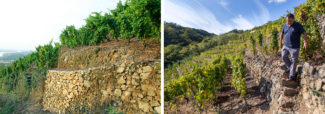
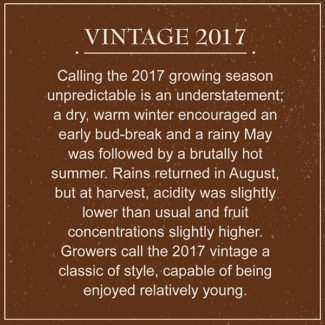 “The majority of our vineyards are set on terraces, making mechanization nearly impossible,” Yves maintains. “Thus, as has been done here for thousands of years, much of the vineyard work is to be done by hand. To control yields, we do extensive de-budding and, when necessary, practice ‘green harvests’ by removing extra grape bunches and balancing leaf area and fruit weight to achieve better ripeness.”
 Northern Rhône’s ‘roasted slope’ is actually a series of sun-harvesting slopes that rise a thousand feet above the Rhône and surround the small town of Ampuis. Despite producing what is arguably the ‘ultimate’ Syrah, the classic black-fruit and bacon aromatics of Côte-Rôtie are often enhanced with the addition of Viognier. Named for the stream that flows at the base of Domaine Yves Cuilleron’s Côte-Rôtie ten acres,
 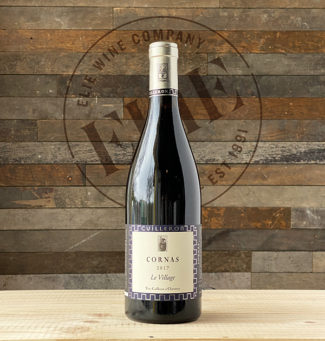 No Viognier is permitted in Cornas; this wine is Syrah in its most honest profile. Consisting of a mere 270 acres on the western bank of the Rhône just south of the Saint-Joseph appellation, the granite in the subsoil of Cornas retains heat while providing rapid drainage, forcing the vines to form deep root systems.
 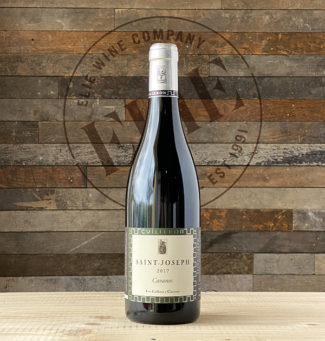 Saint-Joseph covers a lot of territory and multiple terroirs; it encompasses 26 communes and stretches from Chavanay in the north to Châteaubourg in the south, roughly 30 miles in length. The reds from the region can be light for Rhônes, a result of soils containing less granite and vines that face east rather than south. But in strong vintages, they are spectacular.
 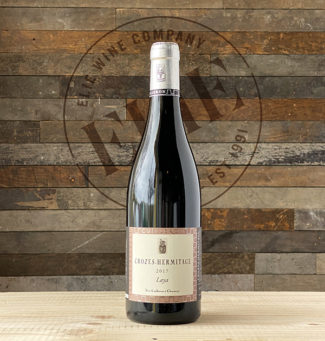 Crozes-Hermitage labors in the shadow of its storied namesake Hermitage, and has no pretentions of equality. Price reflects that, of course, and the wine itself does hold at least some measure of the magnificence found in its massive, long-lived neighbor.
 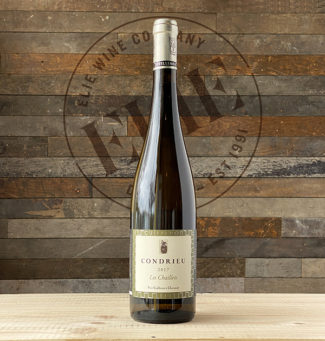 Condrieu is a unique slice of wine country, both in Northern Rhône and arguably, in the entire wine world. Contained within seven parishes, Condrieu’s unique soil chemistry (mixed chalk, flint and mica) produces Viognier of world-renowned distinction, heavily perfumed and full-bodied. Northerly winds traveling up the river keep yields notoriously low; it’s an expensive wine to produce, and as a result, not much is made—for every bottle of Condrieu released, there are ten of Crôzes-Hermitage.
 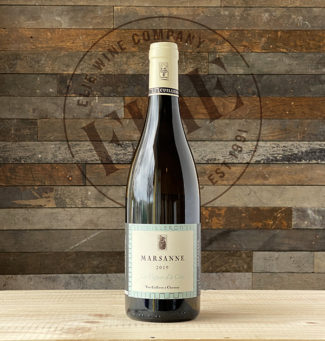 Marsanne is a grape perfectly suited to St-Joseph’s heralded “Terroir de Granit”—it ripens fully in the appellation’s continental climate where it obtains its characteristic deep gold color. This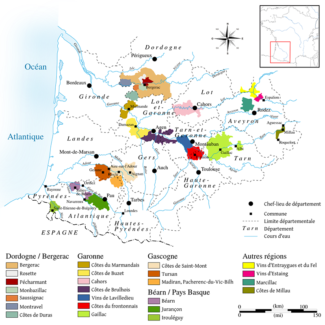
 When he bought
 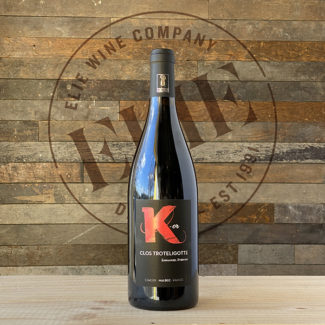 Emmanuel Rybinsky
 Pascal and Jean-Marc Verhaeghe are brothers and collaborators. Having inherited the 67-acre
 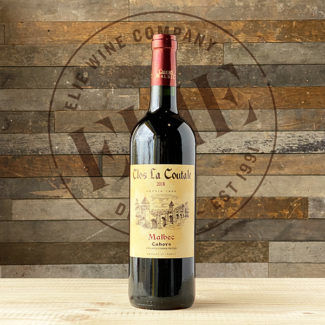 The tradition of winemaking in Cahors is much older than that of Bordeaux, with vines planted by the Romans fifty years before the birth of Christ. The Bernède family has played a significant role in this heritage, today managing a property founded before the French Revolution. To this history, however, Philippe Bernède brings innovation, and his current blend of
  Although not part of the twelve-bottle special,